
NEWS
Taiwanese AI Enters a New Era of Broad Application: Breeze-ASR-26 Establishes a High-Performance Foundation for Innovation
2026-09-07
NATIONAL YANG MING CHIAO TUNG UNIVERSITY, Taiwan — August 21, 2026 — Taiwanese AI has entered a new stage in which a high-performance speech recognition model can directly support application innovation. Breeze-ASR-26 is the result of a collaboration between the AI Voice Research Center at National Yang Ming Chiao Tung University's College of Industry-Academia Innovation and the MediaTek Innovation Base, with both sides jointly advancing its open-source release. A high-performance Taiwanese speech recognition capability is now openly available. With Breeze-ASR-26 openly available, a reusable technical foundation is now in place, allowing students, educators, researchers, startups, and industry developers to focus more directly on apps, edge AI, education, healthcare, and intelligent services. The next phase of Taiwanese AI has entered an application-driven stage, where the defining question is who can create applications with meaningful real-world impact.
The shift is supported by public performance evidence. On the Breeze Taigi Benchmark, Breeze-ASR-26 achieves a character error rate (CER) of 30.13%, lower than the Ministry of Education Taiwanese input method at 30.70%, Yating at 32.11%, Gemini 3 Flash at 32.52%, and Breeze ASR 25 at 49.99% under the same test conditions. More than a benchmark lead, the result indicates that Taiwanese speech recognition now has a publicly tested, openly accessible technical foundation on which downstream applications can be built.
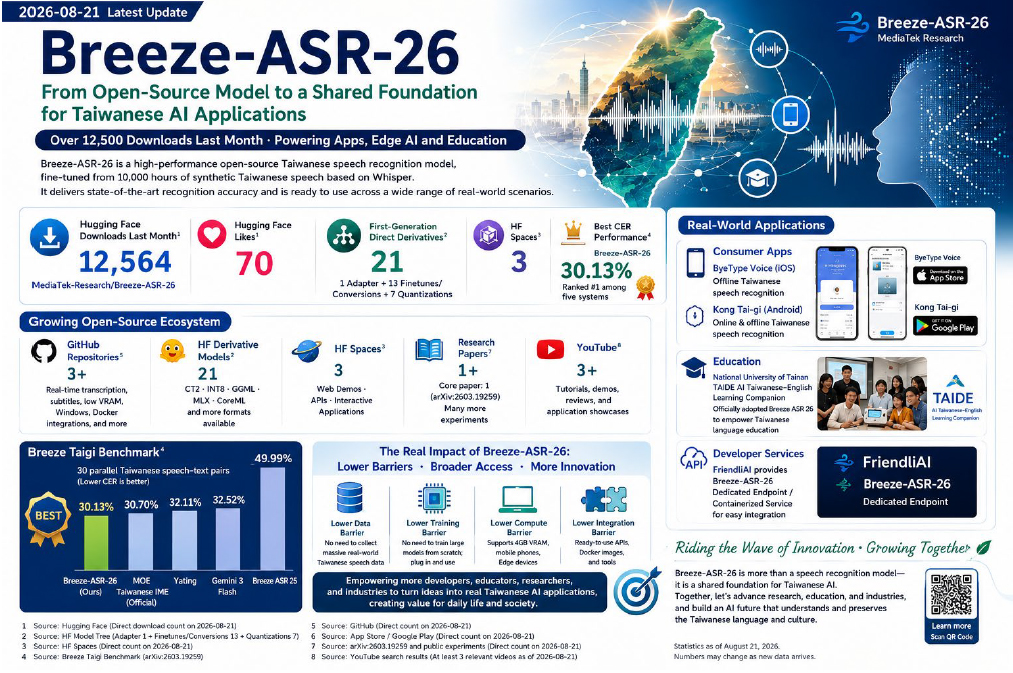
Figure 1. Breeze-ASR-26 is evolving from a high-performance open-source Taiwanese speech recognition model into a shared Taiwanese AI foundation for apps, edge AI, education, research, and services.
From Building the Model First to Building the Application Directly
The model was developed through collaboration between the AI Voice Research Center at National Yang Ming Chiao Tung University's College of Industry-Academia Innovation and the MediaTek Innovation Base, and jointly released as open source. In the past, even teams whose ultimate goal was a Taiwanese learning tool, customer-service system, healthcare voice assistant, or cultural-preservation service often had to begin with data collection and annotation, model training, and GPU infrastructure. Breeze-ASR-26 is built on the multilingual Whisper framework and fine-tuned with roughly 10,000 hours of synthetic Taiwanese speech. Its public release enables downstream teams to build on an existing Taiwanese speech recognition capability and focus on domain adaptation, quantization, edge deployment, user experience, and product integration.
The Benchmark Establishes Usability; the Larger Impact Is Enabling More People to Build
The public Breeze Taigi Benchmark provides an important technical foundation for this shift. Breeze-ASR-26 reports a CER of 30.13%, the lowest among the five systems evaluated; lower CER indicates fewer recognition errors. For application developers, the central question is whether Taiwanese now has a speech recognition model strong enough for others to build on directly. The public results indicate that this threshold has been reached, allowing scarce development resources to move from rebuilding the base capability toward products, services, and domain innovation.
12,564 Monthly Downloads and 21 Derivatives Confirm an Established Open-Source Multiplier Effect
The ecosystem that followed the model's release provides further evidence that the technology has moved beyond the laboratory. As of August 21, 2026, MediaTek-Research/Breeze-ASR-26 shows 12,564 downloads in the previous month and 70 Likes on Hugging Face. Its official model tree lists 21 direct first-generation derivatives, together with three Hugging Face Spaces. Deployment paths spanning CTranslate2, GGML, INT8, MLX, CoreML, and WhisperKit are bringing the same Taiwanese speech recognition capability to servers, personal computers, mobile devices, and edge platforms.
From Apps to Education, Taiwanese AI Has Entered Real-World Use
The shift is already visible in deployed applications. ByeType Voice has added offline Taiwanese recognition based on Breeze-ASR-26; Kong Tai-gi offers online and offline Taiwanese recognition; National University of Tainan has formally integrated Breeze ASR 26 into its TAIDE Taiwanese–English AI learning companion; and FriendliAI offers a Breeze-ASR-26 Dedicated Endpoint. From mobile apps and edge AI to education and developer services, an ecosystem connecting an open model to real-world applications has taken shape.
Data note | 12,564 refers to Hugging Face “Downloads last month,” not cumulative lifetime downloads. The 21 direct derivatives do not represent 21 independent adopting organizations. The 30.13% figure is CER on the Breeze Taigi Benchmark and should not be converted into “69.87% accuracy” or compared directly with recognition rates reported on different datasets.
Primary sources | Breeze Taigi (arXiv:2603.19259), MediaTek Research on Hugging Face, Speech AI Research Center on Hugging Face, Apple App Store, Google Play, National University of Tainan, GitHub, and FriendliAI. Data verified on August 21, 2026.